
Choose the right account type
Your first decision in securing yield is selecting the vehicle that matches your risk tolerance and liquidity needs. In 2026, the landscape is split between traditional banking products and digital asset alternatives. Each offers different returns, but they carry fundamentally different risks.
Traditional savings accounts
High-yield savings accounts (HYSAs) remain the baseline for conservative yield. These accounts are typically offered by online banks that have lower overhead costs than brick-and-mortar branches, allowing them to pass higher interest rates to depositors. The primary advantage is safety: deposits at member banks are insured by the FDIC up to $250,000 per depositor, per institution.
Returns on HYSAs fluctuate with the Federal Reserve’s benchmark rate. When the Fed cuts rates, yields drop accordingly. However, the principal is protected. For money you need within a year or two, or for an emergency fund, this stability is non-negotiable. You can compare current options through financial news outlets like CNBC, which regularly updates guides on short-term investments.
Yield-bearing stablecoins
Yield-bearing stablecoins offer a different proposition. These are digital tokens pegged to the US dollar, but they generate yield through decentralized finance (DeFi) protocols or centralized lending platforms. The APYs can range from 4% to over 14%, significantly higher than traditional bank accounts.
However, this yield comes with exposure to smart contract risk, platform insolvency, and regulatory uncertainty. Unlike bank deposits, these funds are not FDIC-insured. A hack or a protocol failure can result in total loss. This category suits investors who understand the technology and can tolerate volatility in exchange for higher potential returns.
Which should you choose?
The choice depends on your goal. If you are preserving capital for a near-term purchase, stick to HYSAs. If you are seeking maximum yield and can absorb potential losses, stablecoins may offer an edge. Many investors split the difference, keeping an emergency fund in a bank account and allocating surplus capital to digital assets.
Compare top savings options
Savings accounts have become the default parking spot for emergency funds and short-term cash goals. As of July 2026, the national average APY hovers around 0.40%, while top-tier online banks are offering rates near 4.15%. This gap means your money can earn significantly more simply by moving it to a different institution.
When choosing an account, the trade-off is usually between the highest APY and the lowest entry barrier. Online-only banks typically offer higher rates because they have lower overhead costs than brick-and-mortar branches. However, some institutions require a minimum initial deposit to open an account or to qualify for their best tier.
The table below compares the leading savings accounts currently available. All options listed are FDIC insured, ensuring your principal is protected up to $250,000 per depositor, per institution.
| Bank | APY | Min. Deposit | FDIC Insured |
|---|---|---|---|
| Forbright Bank | 4.15% | None | Yes |
| CIT Bank | 4.10% | $100 | Yes |
| Vio Bank | 4.05% | $100 | Yes |
| Ally Bank | 3.85% | $0 | Yes |
| Marcus by Goldman Sachs | 3.75% | $0 | Yes |
| SoFi Bank | 3.65% | $0 | Yes |
Evaluate digital dollar and stablecoin yields
Traditional savings accounts are capping out, but yield-bearing stablecoins offer a different path for securing yield. These assets function like digital dollars while generating returns, often through lending protocols or treasury bill integration. This approach requires a different risk assessment than insured bank deposits.
How yield-bearing stablecoins work
Assets like sDAI and sUSDe are not just static tokens; they are designed to accrue value over time. sDAI, for instance, is a version of DAI that automatically increases in value relative to the original DAI token, reflecting the yield earned from underlying collateral. Similarly, sUSDe is a liquid staking derivative that captures yield from Ethereum staking and treasury bills. Understanding the source of the yield is critical to evaluating the risk.
Accessing the yield
You can access these yields through decentralized finance (DeFi) platforms or regulated crypto exchanges. The process typically involves swapping your USDC or ETH for the yield-bearing asset. Once held, the yield compounds automatically, meaning you do not need to actively stake or claim rewards. However, this convenience comes with smart contract risk, which is absent in FDIC-insured bank accounts.

Regulatory considerations
The regulatory landscape for digital dollars is shifting. While some stablecoin issuers are partnering with regulated banks to hold reserves, others operate on decentralized protocols without central intermediaries. This distinction matters for your security. If you prioritize regulatory clarity, look for stablecoins backed by short-term U.S. treasuries held in regulated trust companies. For those comfortable with DeFi, decentralized lending protocols offer transparency but lack consumer protections.
Note: Yield-bearing stablecoins are not FDIC-insured. If the underlying protocol fails or the collateral depegs, you may lose principal. Always diversify and never allocate more than you can afford to lose.
Comparing yields
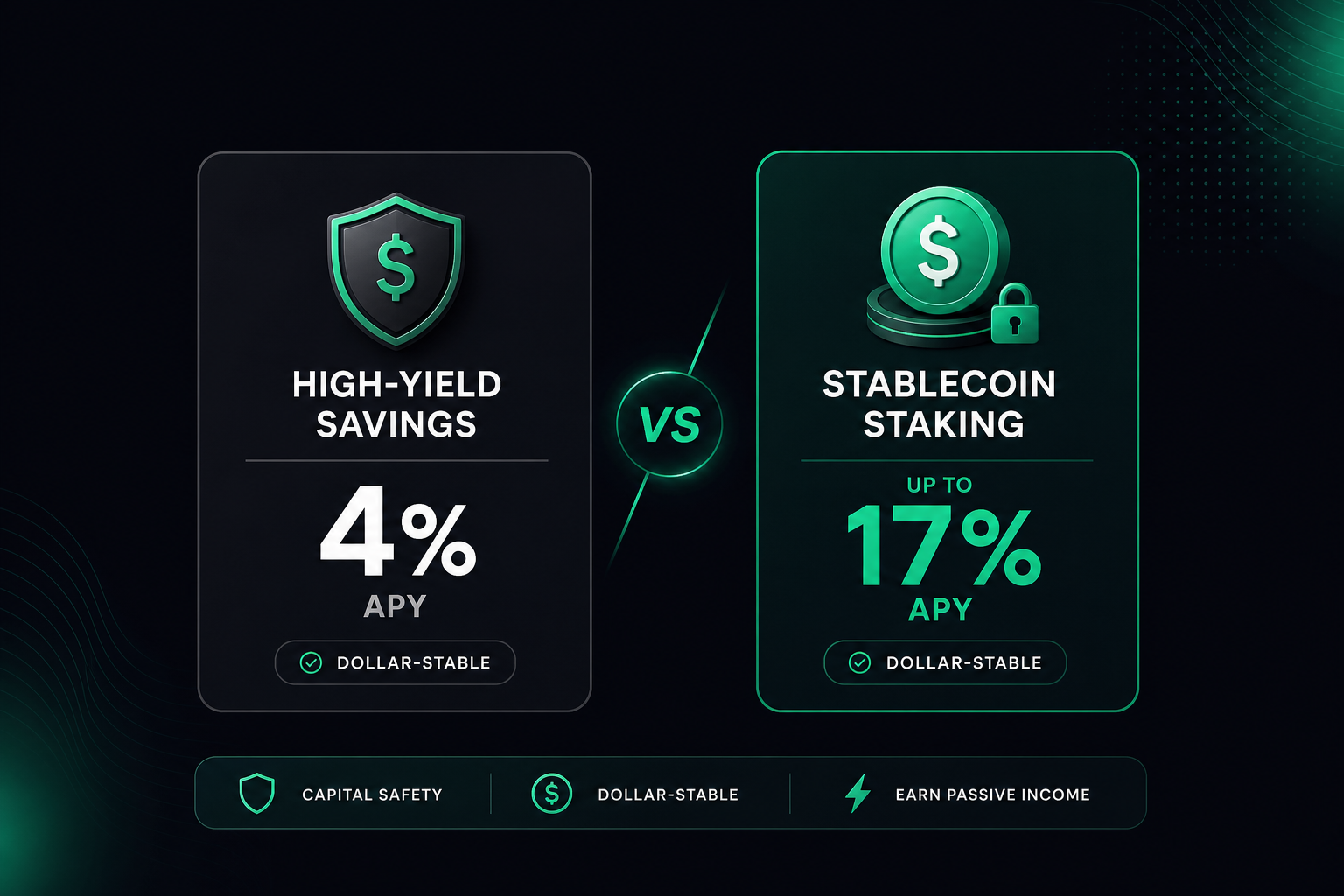
Current APY ranges for stablecoin yields vary widely based on market conditions. While HYSAs offer around 4-5%, stablecoin yields can range from 4% to 14% depending on the asset and platform. This spread reflects the additional risk and complexity involved. For example, sUSDe has historically offered higher yields due to its dual exposure to Ethereum staking and treasury bills, but this also introduces smart contract and staking risks.
| Asset | Approx. APY | Primary Yield Source | Risk Level |
|---|---|---|---|
| sDAI | 3-5% | DAI Savings Rate (DSR) | Low-Medium |
| sUSDe | 5-8% | ETH Staking + Treasuries | Medium |
| USDC (DeFi) | 4-10% | Lending Protocols | Medium-High |
The key is to match your risk tolerance with the yield source. If you are primarily focused on securing yield while maintaining liquidity, stablecoins offer a compelling, albeit riskier, alternative to traditional savings. Always verify the current rates and protocol audits before committing funds.
Open your chosen savings account
With your strategy set, the next step is to actually fund the account. Whether you choose a traditional savings account or a digital stablecoin wallet, the opening process is largely digital and usually takes less than ten minutes. You will need a few specific documents ready to verify your identity.
You must have a government-issued photo ID, such as a driver’s license or passport. Most institutions also require your Social Security Number (SSN) or Individual Taxpayer Identification Number (ITIN) to comply with federal reporting laws. Keep these documents accessible on your device before starting the application.
Before clicking "Open Account," verify the annual percentage yield (APY) and any monthly maintenance fees. Traditional banks often require higher minimum balances to avoid fees, while online-only banks typically offer higher rates with no minimums. Ensure the account structure aligns with your capital amount.
You will need to connect an external checking account to transfer your initial deposit. This usually involves entering your routing and account numbers, or logging into your external bank via a secure portal. For stablecoin accounts, this step involves connecting your crypto wallet (e.g., MetaMask, Ledger) or sending funds from an exchange to your new wallet address.
Most platforms use automated identity checks. You may need to take a photo of your ID and answer a few security questions. If you are opening a crypto-based savings account, you might need to complete additional KYC (Know Your Customer) forms if you are using a regulated custodian rather than a self-custody wallet.
Finalize the account setup by transferring your initial funds. For traditional HYSAs, this is often a wire transfer or ACH link. For stablecoin yields, this is a blockchain transaction. Once the funds clear, your yield generation begins immediately or according to the platform’s compounding schedule.
After opening the account, monitor your first few statements or wallet transactions to ensure the interest is being credited correctly. Traditional banks will send monthly statements, while crypto platforms often display yields in real-time within the dashboard.
Avoid common yield savings mistakes
Securing yield in 2026 requires more than just finding a high interest rate. Many savers lose purchasing power by chasing unsustainable APYs or ignoring the silent erosion of inflation. To protect your capital, you need to look past the headline numbers and understand the underlying mechanics of each savings vehicle.
Don’t chase unsustainable APYs
Banks often offer promotional rates that drop sharply after the first few months. If you lock your money into a product with an artificially high initial yield, you may face lower returns than a standard savings account once the promo ends. Always check the "standard" or "ongoing" APY, not just the introductory offer. This ensures your long-term savings aren’t compromised by short-term marketing tactics.
Don’t ignore inflation
A 4% yield sounds attractive until you realize inflation is running at 3.5%. Your real return is only 0.5%, which barely covers the rising cost of goods. Historically, short-term investments like Treasury bills or CDs often struggle to outpace high inflation periods. Compare the yield against the current Consumer Price Index (CPI) to see if your money is actually growing in purchasing power.
Don’t overlook regulatory changes
Federal insurance limits, such as those from the FDIC or NCUA, have not changed, but banking regulations do. A bank or credit union operating outside these protections may offer higher rates but carries significant risk. Always verify that your institution is insured and that the product type is covered under current federal guidelines to avoid losing your principal.
Verify your savings strategy works
Before locking in a yield stable savings account, run through this final checklist. The goal is to ensure your funds are protected by federal insurance and that the rates you see are actually available.
Savings accounts often offer rates up to ten times higher than traditional banks, but these rates can fluctuate. Always verify the current APY on the provider’s official page, as third-party lists may lag behind real-time changes. For a comprehensive view of current offers, refer to US News Money’s latest rankings or Bankrate’s updated list to compare institutions like Forbright Bank and CIT Bank.
If any item on this list fails, move to the next provider. Security and transparency should always take precedence over the highest possible rate.
No comments yet. Be the first to share your thoughts!